
New Net Billing Policy in Pakistan 2026
Net billing is the new solar policy introduced in Pakistan in 2026, replacing the old net metering system. Under this system, solar users can still export extra electricity to the grid, but instead of getting units in return, they are paid a fixed price for it. This change has shifted the entire concept of solar savings in Pakistan. Earlier, users could significantly reduce or even eliminate their electricity bills, but now savings depend more on how much solar energy you use yourself. The new policy is designed to balance the energy market, but it also requires smarter planning for solar system users. Understanding net billing is very important before installing a new solar system so that users can make better financial decisions and maximize their benefits.
Get Free Site Survey
Get Free Quote
Net Metering vs Net Billing:
Net Metering was the old system where exported electricity units were adjusted against imported units on a one-to-one basis. This allowed users to reduce their bills significantly and even achieve zero bills in many cases.
Net Billing works on a different concept. Instead of unit adjustment, exported electricity is sold at a fixed rate, and imported electricity is charged at the normal tariff. This creates a difference between buying and selling prices, reducing overall savings. Learn more about how Global Energy Solutions can help you save with solar systems.
What Updates Have Been Introduced in Net Billing Policy 2026?
The new policy brings several important changes that directly impact solar users. Below are the key updates explained in detail:
Major Policy Changes:
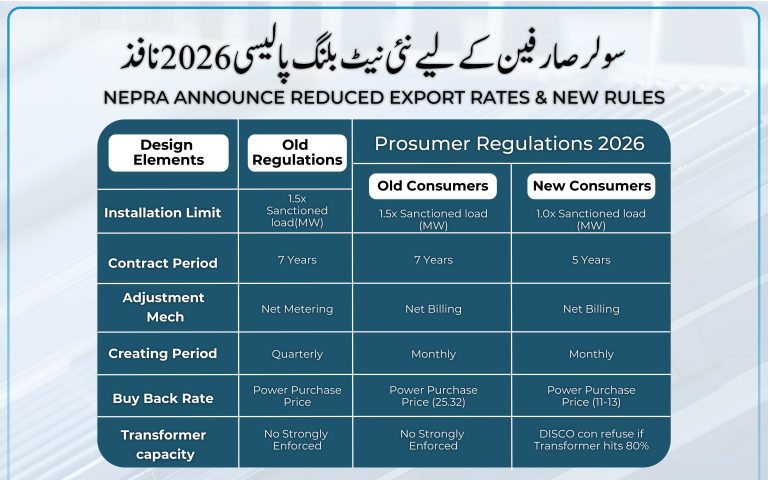
- Net metering system has been replaced with net billing.
- Exported electricity is treated as energy sold to the grid
Buyback Rate Reduction:
- Old rate: around Rs. 25–26 per unit
- New rate: around Rs. 10–11 per unit
- Export income reduced by 50–60%
- Selling extra electricity is now less profitable.
Import Electricity Charges:
- Grid electricity price: approx Rs. 37–55 per unit
- Users must pay full tariff for imported electricity
- Large difference between import and export rates
Contract Duration Change:
- Old duration: 7 years
- New duration: 5 years
- Reduced long-term financial security.
System Size Limitation:
- You can only install a solar system according to your approved (sanctioned) load
- You are not allowed to install a bigger system just to export extra electricity
- The system should match your actual electricity usage.
Settlement & Billing Method:
- Billing is still done in money, not direct unit adjustment like before
- Your exported and imported units are calculated separately every month
- The settlement of units is valid for only one month
- Any extra exported units are adjusted within that same month only
- After the month ends, unused units/benefit does not carry forward like before.
Transformer Capacity Limit:
- New connections may be restricted if transformer reaches 80% capacity
- Can delay or block solar approvals in some areas.
Additional Costs:
- Interconnection charges may apply
- Concurrence fee per kW may be required
- Initial investment cost may increase
Existing Users Protection:
- Old net metering users will stay on old policy
- Until their contract expires
Impact of Net Billing Policy on Solar Consumers:
The latest net billing policy has changed how solar users benefit from their systems. The biggest impact is the reduction in export income, which increases the payback period of solar installations. Users can no longer rely on exporting excess electricity to recover their investment quickly.
However, solar energy still provides strong benefits if used efficiently. Consumers who use most of their electricity during the daytime can still achieve good savings. The policy mainly shifts the focus from earning through export to saving through self-consumption.
Best Solar Solution After Net Billing Changes in Pakistan:
After the introduction of net billing, the best approach is to design a system that maximizes self-consumption. Users should try to use heavy appliances during the daytime when solar production is high.
A Hybrid Solar System is now considered one of the best solutions because it allows users to store excess electricity in batteries and use it later at night. This reduces dependency on the grid and improves overall savings.
The net billing policy in Pakistan 2026 is a major shift in the solar industry. While it reduces the benefits of exporting electricity, it still supports solar adoption by encouraging efficient energy use. The key to success under this system is proper planning, smart usage, and choosing the right type of solar system. Hybrid systems, in particular, offer a strong advantage by storing energy and reducing reliance on expensive grid electricity. With the right strategy, solar energy remains a valuable and future-proof investment in Pakistan.